
A Way To Compile A European Atlas of Plant-Pollinator Associations

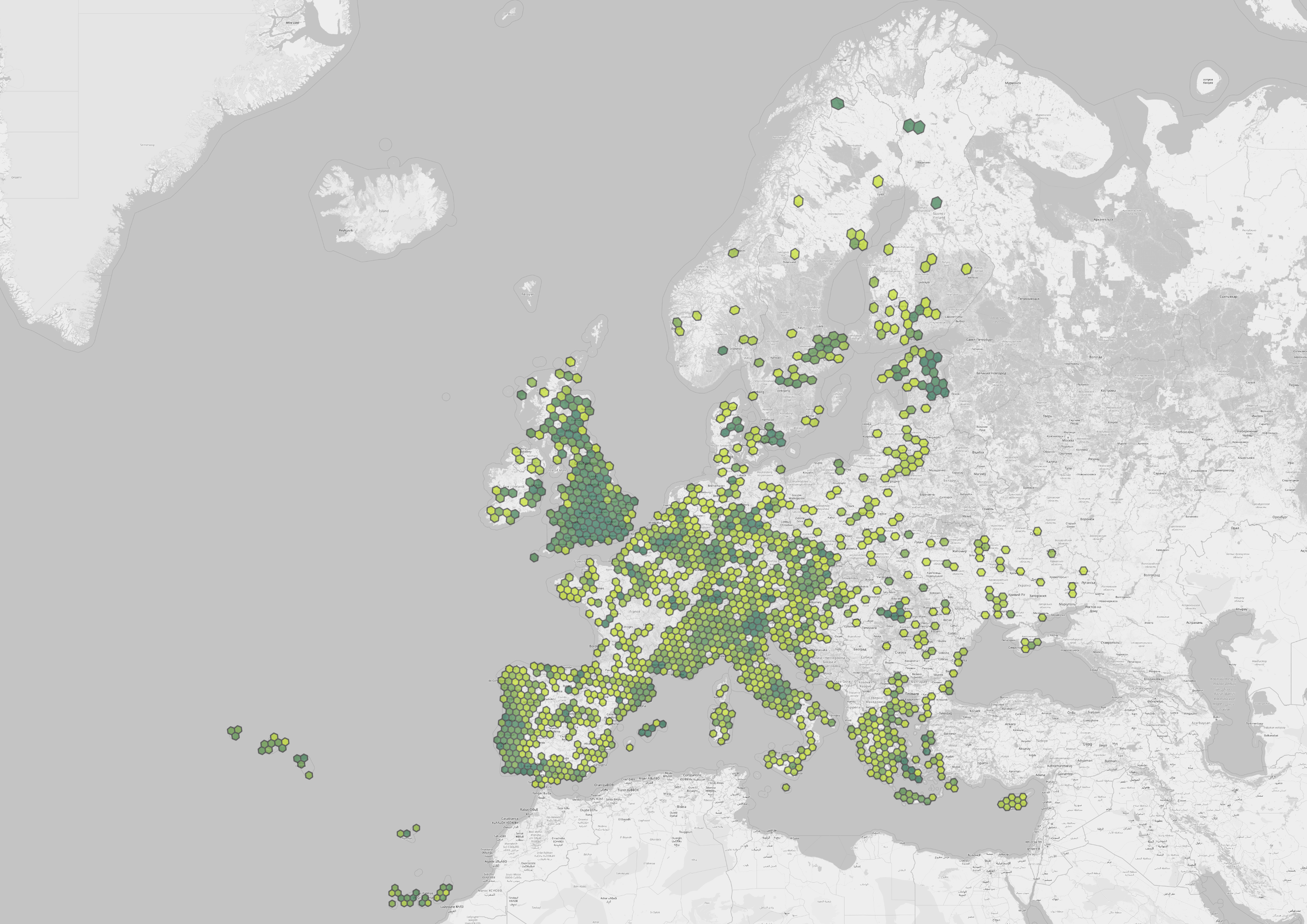
Many openly accessible datasets exist that describe how plants interact with their pollinators (e.g., bees, bats, birds). And, a EU Horizon project “Butterfly” [1] aims to use existing data, complemented by field observations, to establish EuroAPPA, a European Atlas of Plant Pollinator Associations.
There’s many ways to build such an atlas and the text below describes one of them. The method below demonstrates how to combine an existing GloBI Corpus of Review Data [4] and Eurostat/GISCO Geographical country data with DuckDB [2], a small but mighty database, and QGIS, an open source geographic information system tool to create maps to show the geographic distribution of existing flower visitation and pollination record claims.
Getting the Data
A Dec 2025 compilation of GloBI reviewed datasets is available through:
Poelen, J. H. (ed.), & Global Biotic Interactions Community. (2025). Global Biotic Interactions (GloBI) Review Dataset Corpus hash://md5/c326e584fb61f95d0075710c63dc2a33 [Data set]. Zenodo. https://doi.org/10.5281/zenodo.18064921
This compilation dataset includes a derived file that includes reviewed interaction records in a gzipped tab-separated format interactions.tsv.gz with digital fingerprint hash://md5/7c12420410e0fea43608308c387fa89c .
Also, a GeoPackage CNTR_RG_20M_2024_4326.gpkg with digital fingerprint hash://md5/8f345c975eb2ba6b1c92ea1ae27ec4cf was retrieved from https://ec.europa.eu/eurostat/web/gisco/geodata/administrative-units/countries on 2026-01-21 to help delineate current administrative boundaries of countries of interest.
Building A GeoPackage Using DuckDB
Using the GloBI data review corpus and downloaded Eurostat/GISCO geographical data, a GeoPackage euroappa.gpkg was created by selecting only georeferenced flower visitation and pollination claims within EU countries in addition to the United Kingdom, Norway, Switzerland and Ukraine.
More specifically, the GeoPackage euroappa.gpkg was generated by running using DuckDB v1.2.1 8e52ec4395 as follows:
cat generate-euroappa.sql | duckdb
with generate-euroappa.sql containing:
INSTALL spatial;
LOAD spatial;

CREATE TABLE IF NOT EXISTS interactions
AS SELECT
  ST_POINT(decimalLongitude,decimalLatitude) as location,
  decimalLatitude,
  decimalLongitude,
  sourceTaxonName,
  interactionTypeName,
  targetTaxonName,
  "http://rs.tdwg.org/dwc/terms/eventDate" as eventDate,
  referenceCitation,
  citation,
  namespace,
  lastSeenAt
FROM
  'interactions.tsv.gz'
WHERE
  interactionTypeName IN ('flowersVisitedBy','visitsFlowersOf', 'pollinates', 'pollinatedBy')
  AND
  ST_IsValid(location);


CREATE INDEX IF NOT EXISTS my_idx ON interactions USING RTREE (location);

COPY (
 SELECT interactions.*, countries.ISO3_CODE
 FROM interactions
  JOIN (
    SELECT
      geom AS country,
      ISO3_CODE
    FROM
      'CNTR_RG_20M_2024_4326.gpkg'
    WHERE
      EU_STAT = 'T'
      OR
      ISO3_CODE IN ['GBR', 'NOR', 'CHE', 'UKR']
  ) AS countries
  ON ST_Within(interactions.location, countries.country)
) TO 'euroappa.gpkg'
WITH (FORMAT gdal, DRIVER 'GPKG', SRS 'EPSG:4326');
Clustering Data using DuckDB and H3
The resulting geopackage was clustered using h3 [3] on resolution level 4 (less granular) and 6 (more granular) to highlight the geographic distribution of flower visitation and pollination claims. These clustered data were packaged in data files euroappa-h3-level-4.gpkg and euroappa-h3-level-6.gpkg respectively and generated by:
cat generate-euroappa-h3-level-6.sql | duckdb
with generate-euroappa-h3-level-6.sql containing:
INSTALL spatial;
LOAD spatial;
INSTALL h3 FROM community;
LOAD h3;

COPY (
  SELECT
    ST_GeomFromText(h3_cell_to_boundary_wkt(h3_cell)) AS cell_boundary,
    number_of_records
  FROM (
    SELECT
      h3_latlng_to_cell(ST_Y(geom), ST_X(geom), 6) AS h3_cell,
      LOG(1+COUNT(*)) AS number_of_records
    FROM
      'euroappa.gpkg'
    GROUP BY
      h3_cell
  )
) TO 'euroappa-h3-level-6.gpkg'
WITH (FORMAT gdal, DRIVER 'GPKG', SRS 'EPSG:4326');
Visualizing Geospatial Maps Using QGIS
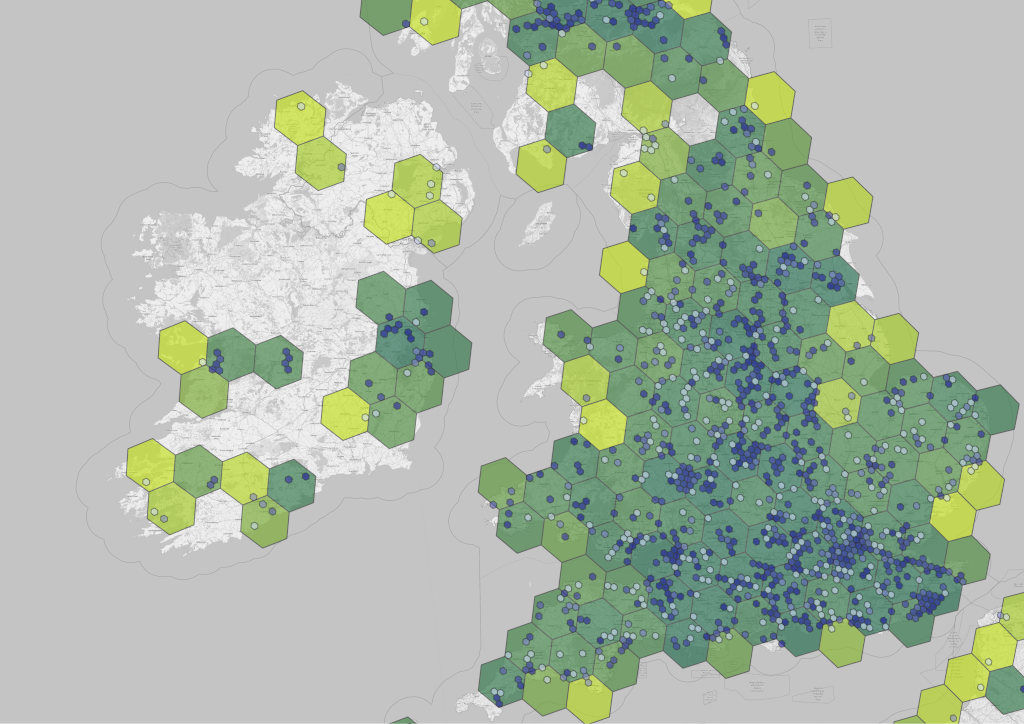
After creating the geopackages, QGIS v3.34.4-Prizren was used to visualize the h3 geopackages and put them on a map of the world provided by OpenStreetMap. Figures 1., and 2. highlight geographic areas with higher (darker), lower (lighter), or no data coverage. The larger yellow/green hexagons are at h3 resolution level 4, whereas the smaller blue hexagons are a more granular scale, at h3 resolution level 6. All with © OpenStreetMap contributors and © EuroGeographics for the administrative boundaries .
Discussion
Our examples show that geographic maps indicating data availability of flower visitating and pollinator records can be generating using openly available datasets (e.g., GloBI data review corpus, Eurostat/GISCO geographical data) and open source data processing and visualization tools (e.g., DuckDB, QGIS).
References
[1] BUTTERFLY: Mainstreaming pollinator stewardship in view of cascading ecological, societal and economic impacts of pollinator decline. 2025. CORDIS / Horizon Europe doi:10.3030/101181930
[2] Mark Raasveldt and Hannes Mühleisen. 2019. DuckDB: an Embeddable Analytical Database. In Proceedings of the 2019 International Conference on Management of Data (SIGMOD ‘19). Association for Computing Machinery, New York, NY, USA, 1981–1984. https://doi.org/10.1145/3299869.3320212
[3] Brodsky, I., 2019: H3: Uber’s Hexagonal Hierarchical Spatial Index. Available online: https://eng.uber.com/h3/ Accessed January 22, 2026
[4] Poelen, J. H. (ed.), & Global Biotic Interactions Community. (2025). Global Biotic Interactions (GloBI) Review Dataset Corpus hash://md5/c326e584fb61f95d0075710c63dc2a33 [Data set]. Zenodo. https://doi.org/10.5281/zenodo.18064921
Contributing Datasets
The following datasets contributed to the data and maps in figures 1. and 2. For completeness, their associated data reviews are included also.
Groom, Q.J., Maarten De Groot, M. & Marčiulynienė, D. (2020) Species interation data manually extracted from literature for species . Associated data review: Elton, Nomer, & Preston. (2025). Versioned Archive and Review of Biotic Interactions and Taxon Names Found within AgentschapPlantentuinMeise/ashForestInteractions hash://md5/2273176929e38071b21a6438df74d484. Zenodo. https://doi.org/10.5281/zenodo.16416287
Pocock, Michael J. O.; Evans, Darren M.; Memmott, Jane (2012), Data from: The robustness and restoration of a network of ecological networks, Dryad, Dataset, https://doi.org/10.5061/dryad.3s36r118. For associated GloBI review see: Elton, Nomer, & Preston. (2025). Versioned Archive and Review of Biotic Interactions and Taxon Names Found within globalbioticinteractions/pocock2012 hash://md5/d8f6d8ddafbf5a4bbd6a7bf2cc798f69. Zenodo. https://doi.org/10.5281/zenodo.16416381
Web of Life. http://www.web-of-life.es . For associated GloBI review see Elton, Nomer, & Preston. (2025). Versioned Archive and Review of Biotic Interactions and Taxon Names Found within globalbioticinteractions/web-of-life hash://md5/df58ae253b9a759e387c7f78d05de592. Zenodo. https://doi.org/10.5281/zenodo.16416701
Cristina Preda and Quentin Groom. 2014. Species associations manually extracted from literature. For associated GloBI review see Elton, Nomer, & Preston. (2025). Versioned Archive and Review of Biotic Interactions and Taxon Names Found within qgroom/Vespa-velutina hash://md5/590d7f2941c8c31bfafb4afd4a3a4368. Zenodo. https://doi.org/10.5281/zenodo.16415902
http://iNaturalist.org is a place where you can record what you see in nature, meet other nature lovers, and learn about the natural world. For associated GloBI review see Elton, Nomer, & Preston. (2025). Versioned Archive and Review of Biotic Interactions and Taxon Names Found within globalbioticinteractions/inaturalist hash://md5/2865258bf6e685b25a42f471a2a45475. Zenodo. https://doi.org/10.5281/zenodo.16416416
Sarah E Miller. 6/19/2015. Species associations manually extracted from datasets https://www.nceas.ucsb.edu/interactionweb/resources.html. For associated GloBI review see Elton, Nomer, & Preston. (2025). Versioned Archive and Review of Biotic Interactions and Taxon Names Found within millerse/Plant-Pollinator-Web hash://md5/6d203140d0d7041ddb68493aa1afdd3c. Zenodo. https://doi.org/10.5281/zenodo.16415795
Allen-Perkins, Alfonso, Magrach, Ainhoa, Dainese, Matteo, Garibaldi, Lucas A., Kleijn, David, Rader, Romina, Reilly, James R., et al. 2022. “CropPol: A Dynamic, Open and Global Database on Crop Pollination.” Ecology 103(3): e3614. https://doi.org/10.1002/ecy.3614. For associated GloBI review see Elton, Nomer, & Preston. (2025). A Review of Biotic Interactions and Taxon Names Found in ibartomeus/OBservData hash://md5/35b1210f8b22088babe73b2b9012c15e. Zenodo. https://doi.org/10.5281/zenodo.15256406
Sarah E Miller. 5/30/2016. Interations from various papers. For associated GloBI review see: Elton, Nomer, & Preston. (2025). Versioned Archive and Review of Biotic Interactions and Taxon Names Found within millerse/Pollination-Collection hash://md5/45e01a3d185bebefe0c817999626e52e. Zenodo. https://doi.org/10.5281/zenodo.16415773
Jakovos Demetriou and Quentin Groom 2014. Species associations of Sceliphron manually extracted from literature. For associated GloBI review see Elton, Nomer, & Preston. (2025). Versioned Archive and Review of Biotic Interactions and Taxon Names Found within qgroom/Sceliphron hash://md5/8b608b17e34230c5b4697504e6ff98a5. Zenodo. https://doi.org/10.5281/zenodo.16415968
Balfour, N.J., Castellanos, M.C., Goulson, D., Philippides, A. and Johnson, C., 2022. DoPI: The Database of Pollinator Interactions. Ecology, 103, e3801. For associated GloBI review see Elton, Nomer, & Preston. (2025). Versioned Archive and Review of Biotic Interactions and Taxon Names Found within globalbioticinteractions/dopi hash://md5/5092adc224b66f397c752f6f2071ed53. Zenodo. https://doi.org/10.5281/zenodo.16416445
Lanuza et al. (2025), EuPPollNet: A European Database of Plant-Pollinator Networks. Global Ecol Biogeogr, 34: e70000. https://doi.org/10.1111/geb.70000. For associated GloBI review see Elton, Nomer, & Preston. (2025). Versioned Archive and Review of Biotic Interactions and Taxon Names Found within JoseBSL/EuPPollNet hash://md5/346321bf93ff80852d25f24efaafb18d. Zenodo. https://doi.org/10.5281/zenodo.16416096
Simone Lioy, Cristina Preda and Quentin Groom. 2022. Vespa velutina biotic interactions extracted from literature. For associated GloBI review see Elton, Nomer, & Preston. (2025). Versioned Archive and Review of Biotic Interactions and Taxon Names Found within SimoneLioy/Vespa-velutina-interactions hash://md5/b78cec2bb01456dd3f802601f30b9bd5. Zenodo. https://doi.org/10.5281/zenodo.16416070
The International Barcode of Life Consortium (2016). International Barcode of Life project (iBOL). Occurrence dataset https://doi.org/10.15468/inygc6. For associated GloBI review see Elton, Nomer, & Preston. (2025). Versioned Archive and Review of Biotic Interactions and Taxon Names Found within globalbioticinteractions/bold hash://md5/969227ee2bf361797a9508ba886bad24. Zenodo. https://doi.org/10.5281/zenodo.16416838
Menares, Esteban (2025): Literature-based, long-term interaction database for grasslands vascular plants and day-active (adult) Lepidoptera, region Brandenburg including Schorfheide-Chorin, 1960 to 2018. Version 4. Biodiversity Exploratories Information System. Dataset. https://www.bexis.uni-jena.de/ddm/data/Showdata/31736?version=4; Menares, Esteban (2025): Literature-based, long-term interaction database for grasslands vascular plants and day-active (adult) Lepidoptera, region Baden-Württemberg including Schwäbische Alb, 1975 to 2005. Version 9. Biodiversity Exploratories Information System. Dataset. https://www.bexis.uni-jena.de/ddm/data/Showdata/31734?version=9 . For associated GloBI review see Elton, Nomer, & Preston. (2025). Versioned Archive and Review of Biotic Interactions and Taxon Names Found within globalbioticinteractions/menares2025-flowervisitation hash://md5/833c72e7a4f443b8732431aca3c7ed36. Zenodo. https://doi.org/10.5281/zenodo.16898846

